Wednesday, April 4, 2012

Hands On


So, if my mind's not quite in the game, my body can still go there. Sloughing off the winter is close to being my favorite time of a horse-owning year. I dig in with my few simple tools and work at it until my shoulders burn. The horse loves it as much as I do, just differently. She loves the pressure of my raking through her coat over and over, leans into it, sighs. I love the feel of chasing a seam, like coal, finding the glitter gleam under lifeless shale.


The brittle strands sometimes levitate in the surrounding air - they cleave to my lips before long, line an eye. I pull and drag her contours, following her every small shift of position without thought. If only I could peel off my own shit like I can peel off what she's already cast away. But I don't think about things like that then, only notice sometimes the burning in my wrists, the sweat at my brow. It's satisfying, relieving, a little freeing.


Afterward, lingering at the doorway, she seems to smile. That can be enough. It can be enough for what it was. She looks beautiful.

Wednesday, March 21, 2012

Closing The Weave

I really did step back from my mare, and it's been a strange kind of hard work to do it. I wrote about needing time to let a bad horse year go and begin another one fresh. Then I imagined an encircling winter, the kind that brings to mind weathering it out on an 1800s prairie, living the punishing days by rote until the thaw. For me, there's renewal in that kind of waiting. What I imagined isn't quite how it went, though. There have been too many days of mildness and the weather has disoriented me in my own thinking. It's like it's summer and I've already lost the spring, squandered the spring. At least, I have those shimmers of guilt.


Then I found this amazing picture. It's not possible to say all that I see in it, all that I think about it. I can say it really stirred me up. How she clutches that horse to her, how she hunches protectively, the tension plain to see. I felt like that a couple of times last year. Her fierceness - I felt that. The sweet compliance of her mare even reminds me of my own.

Once I had a horse, Scout, who was attuned to every tension in my body. It wasn't a good thing for us as a team under saddle, but it was oddly validating, a kind of direct proof that things were going on in me, in my life. She could remind me of how bad I felt, how wound up I was with the churning of things. She reflected it and that brought us close together. I don't have that with Saxony; she's not that kind of horse. I have to bring myself down to be with her, drop out of my head, come closer to simplicity. It's really hard. She wants her rubs, her dawdles, her German muffins, our gazing eye to eye. She doesn't know that I'm a mind-rooted existentialist and she doesn't feed off my auto-cues of anxiety and doubt, either unwitting or overt. It means she can never become part of my drama unless I drag her there. I know that is a good thing, but I also know that's why it's taking me so long to come back to her. I am trying to discard things in my life I don't need or want anymore, trying to discard those things from myself.

My mare may be unbalanced, but she travels easier in herself right now than I, who can walk a straight line effortlessly but still struggle to get out of my own way.

Thursday, March 8, 2012

A Life Lived Rough

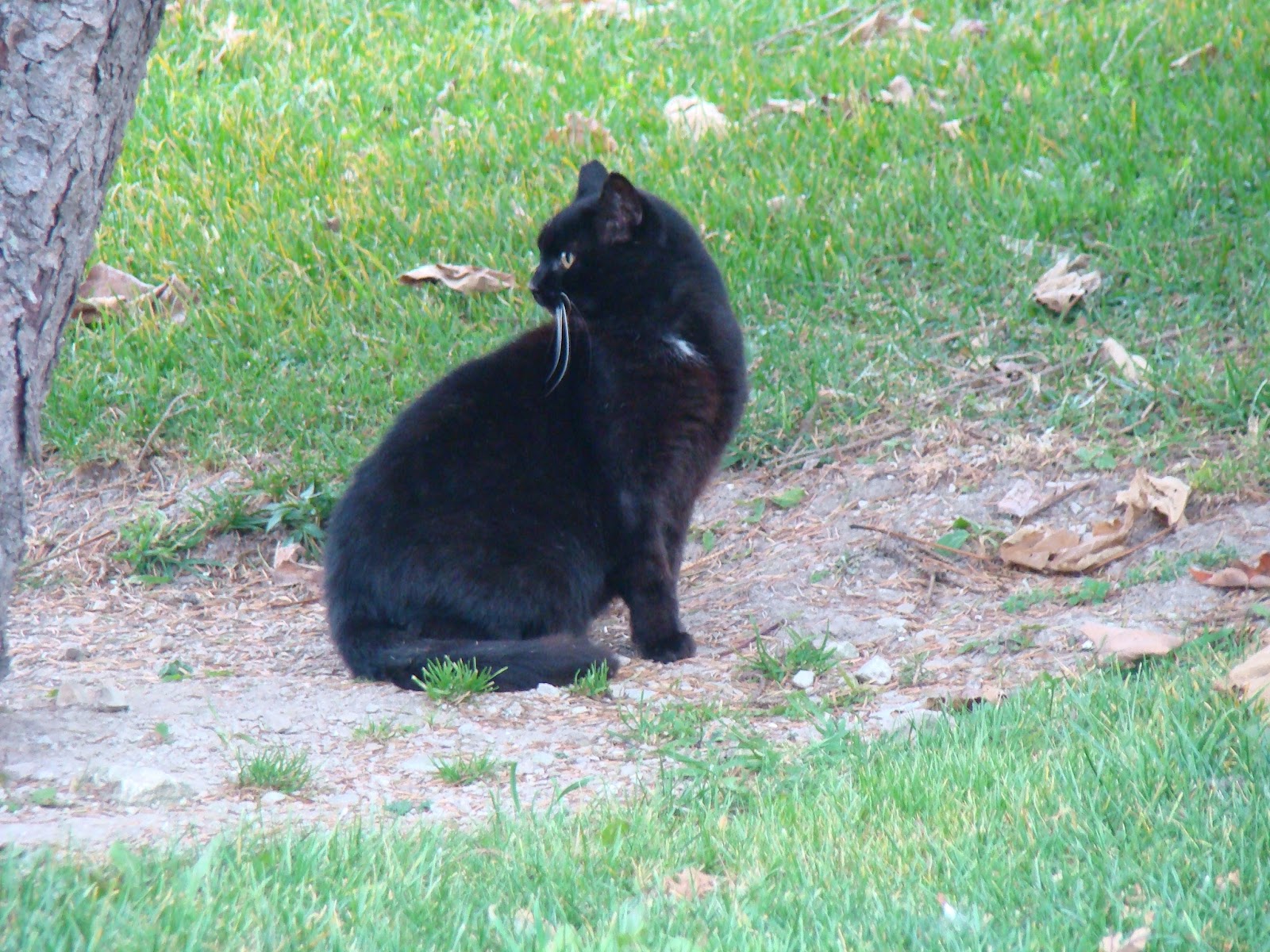
She was a cat who lived, island-like, at the fair. She would not come anywhere near the human side of life. Over the years, she cranked out litter after litter. I stole and kept some of her kids, deceiving her away from them with daily food.


In 2008, I baited a live trap and caught her. I got her spayed and ear-tipped, knowing she would always be wild. In fact, she broke out of my office the night I locked her there to recover from the spay. But she came to expect the food. We worked out an understanding, of sorts. I wouldn't try to tame her, she wouldn't run from me.


Each autumn, I left the fair to move back to the city, knowing that I would worry about her making it through the winter. I left an automatic feeder, outdoor heating pad and a heated water bowl. It was never enough, though: I had to drive down and check. I think the moment I got her spayed, I had to assume responsibility for her.


So in 2010 I trapped her one more time - it took days because she was wise to me by then - and moved her to the farm where I kept my horses. Up in the hayloft, I released her from the trap. She darted to the wall opposite of where I crouched. "This is where you live now, Harlotta," I told her. "I can feed you every day and you can be master of all you survey. Please stay here."

And she did stay. Even when that farm blew apart and I had to leave, she stayed. It was impossible for me to catch her and take her with me. Instead, someone very kind there took over for me. I brought food out from time to time, and I knew she was all right, but it haunted me that I'd left her. It didn't matter to her, though, and why should it have? Her needs were met, and they continued to be met after I was gone.


She listened to me. She never left that farm, and that's where she died, in her sleep, on Sunday morning. Now I can let go of her in the only way I ever wanted to, with peace of mind and relief. Hers was a life lived so roughly, but still, it ended in a better place.

Thursday, February 16, 2012

The Deeper Why

There was a story in the news today about someone near Fresno, California, who won a fat lottery payout 10 years ago, setting him up for life (enough to set any ordinary person up for life, I'd guess.) So this winner went out and bought himself a ranch, like you do. He had 11 horses there. Yesterday eight of the horses, starving, were removed from the property. The other three will be removed today. Stories like this one are common, of course, regular as a kind of busted clockwork; just when you think it's stopped, the thing starts ticking again. Every story like this that I come across causes heart cringe in me, an unmistakable impulse of compassion, anger and sorrow. When you're wired that way, there's nothing that can be done to avoid the feeling.

Fresno Bee Photograph

But just once, I wish the reporters would investigate the deeper why. What is an animal to someone who isn't instinctively drawn to them? What is an animal to someone who is indifferent to them? How can they be less than living, be forgotten like an unwanted object? How does one disregard that they are there? These seem like silly, naive questions because the answers seem reflexively obvious, but the real answers aren't obvious to me at all.

I have a long commute to work. In the evening, driving back, I pass through a huge freeway interchange before exiting home. This mild winter I've seen two cats hunting on the high shoulder near my exit, inside the chain-link fence meant to keep them out. They're hardscrabble cats who seem wise to the traffic. I look for them with every drive. Sometimes I see them, sometimes not. When I don't see them, I look for them dead in the lanes. They're junk cats, abandoned strays or maybe urban ferals who've never known human contact. Still, I think about ways to catch them, can't help it. They're never not living to me. I have to take note of their welfare.

I want to understand what it's like to look at animals in need and feel nothing, not hate, not indifference, just nothing. I wonder what it is to see them from that perspective. What do such people know about themselves? How do they experience their sense of self? It's not the shocked How could they that I want to hear, it's the deeper Why do they. I want a reporter to explore that so I can check my judgment, because it is harsh and unforgiving.

Sunday, February 12, 2012

Latitude Time, Longitude Horse

So I opened a vintage horse shop on Etsy shop in January because I like to dream it will pay for my sweet mare to have all that she needs, pay for me to continue with my riding instructor, pay for me to one day be looking out over verdant fields, musing over which of the three marvelous, suited-in-all-ways horses I shall ride just then, long freed from work I've lost the heart for and a place I've never ever thought of as home...

Ahh, dreams. That's a lot of freight to hang on a little cyber-commerce. But the shop is there, weaned off my wishing and moving on unsteady legs toward my wanting. What a magical thing it gave me yesterday.


In the evening, someone purchased this vintage photograph from my shop. I'd called the photo Shot In the Heart and written about all the details I'd noticed in it. I wrote about the kind hands of the rider and the strength of the well-built pony. I wrote about the Shriner at background right and the little girl at background left, whip-lashing her neck at the sight of the pony as her mother leads her by the hand. It was that very same girl, grown now and horse-fevered all her life, who bought the picture. She recognized herself and wrote me a wonderful note with her order; instantly we were bonded through years, space and time; we were bonded through horses.

Value of my time: nothing much. Value of the photograph: $7.50. Value of her finding it: Priceless.

Tuesday, January 31, 2012

Michael Clayton - Looking at Horses

Thinking about Cave of Forgotten Dreams reminded me of a movie that's really never left me since I saw it. It's not a movie about horses any more than Cave of Forgotten Dreams is about horses, but horses appear in Michael Clayton just as powerfully as they appeared in Herzog's documentary. And two years after seeing it, I still think of those horses.


Michael Clayton is an interesting and complex legal thriller starring George Clooney and Tilda Swinton. Among its plot points are a lawyer who may or may not have had a nervous breakdown, a defense attorney who may or may not be corrupt, a death that may or may not have been a suicide, and a car explosion that may or may not have been intentional. Clooney plays the title character, an attorney with a gambling problem who's been working as the "fixer" for a high-powered New York law firm. He's called in to clean up messes caused by clients or members of the firm. Because his own life is a wreck, he can hardly judge the lives of those he bails out of ugly situations, but it's wearying work.

Michael Clayton depends on a four-day flashback that makes up most of the film. That flashback begins during a scene with horses and we return to the same horses when the story has caught up to the present day. It's a simple scene. The tired, burned-out Michael Clayton pulls over on a country road and gets out of his car when his attention is drawn to a hillside. He walks up the hill. There, three haltered horses stand side by side at the corner of their pasture. He approaches them, lifting his arms a little, palm up as if to tell them he won't harm them, and then he just stands there, looking at them. They look at him (and they really do). The camera cuts to each horse's face, then pans across them as a group. There's an occasional cut back to Clayton, whose expression is that of a troubled man seeking solace, understanding, redemption, peace.

The thing is, I don't know if the horses were in the original script or they were added by the director. What I'm sure of, though, is that whoever included them knew something about horses. It's why they chose to use them rather than, say, deer. It seems to me they knew that looking eye to eye at horses can strip you back to yourself if you've added too many layers or bring you back to yourself if you've forgotten who you are.

Sometimes I just step back from my mare and I look at her. She looks at me. I look at her. I don't do it enough, but I do it. Each time, I get that subtle recalibration that reminds me who I am, whether I like it or not. That's exactly what happens in Michael Clayton, and that's why I'll always think of it as a horse movie.

Monday, January 23, 2012

Cave of Forgotten Dreams

You know how there's that dinner list thing, where people talk about who they'd invite for dinner, anyone from any time? Werner Herzog, the director of Cave of Forgotten Dreams, has been on that list of mine for a long, long time. I see every film he makes, documentary or fiction. I believe he's an archivist by nature, profoundly interested in excavating human truths and preserving them for the future. Perhaps that's why he felt such a deep urge - and sense of urgency - to film the paintings discovered in the Chauvet Cave in southern France.

In a way, the modern mind can't quite relate to the drawings in the cave. Grasping that you are looking at images created some 32,000 years ago is akin to knowing in real senses what one billion dollars is. In the end, it's theoretical.


Except for these horses...


We can look at all of the images (but for those that are concealed behind stalactite and stalagmite formations) from Chauvet Cave because they are widely available on the Internet. We can see drawings of human figures, bears, big cats, water buffalo, bison, and some animal species that vanished thousands of years ago. They are all interesting to look at, even as the mind searches for any kind of foothold to know what kind of people created them. Because to know they weren't people like us tells us nothing, really.

But in his film, Werner Herzog returns again and again to these horses. (I wish I knew how to make and link in a sound file of his voice as he says "the horses" in that wonderful round, slightly thick German tone of his.) I don't know what pulled him back to the horses, but I know I couldn't wait for the camera to return to them. Because these horses stand apart from the rest of the drawings. Maybe it's how they were drawn, the complexity of the group of them, the four different colors and sizes of them, the clarity with which they were depicted. It's as if the artist meant to paint them in exacting, painstaking detail, meant exactly to capture the what-they-are-ness of them. I think that intention is there. But what does that mean, what does that say about horses, I wondered to myself, watching the film. Herzog mentions in his running commentary that horses were hunted as food, among other things. Yes, but still, I can't help but feel that the human being who painted these four horses saw something more in them, understood something more. And oh, to know what that might have been.